6 min read
The Most Profitable Minute in History (yet)
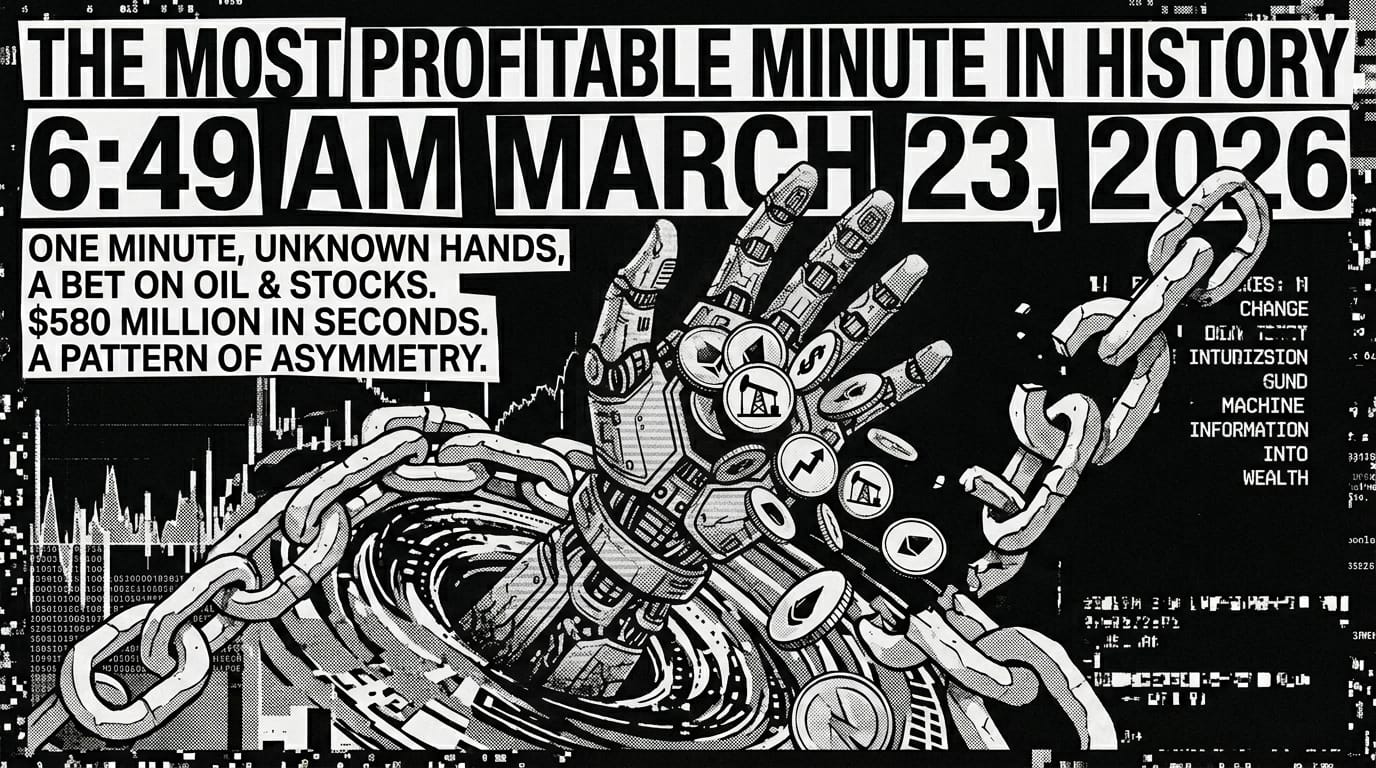
At 6:49 AM on March 23, 2026, someone placed a trade.
Not a complicated one. Not a genius move of quantitative finance. Just a bet: oil prices are going down, stocks are going up. The kind of trade a half-decent analyst might make on any given Monday.
Except it was placed at 6:49 AM, on a Monday with no scheduled news, no Fed speakers, no economic data releases. A premarket hour so quiet it barely registers in the logs.
One minute later, someone else had already done the same. Then another.
By 6:50 AM, $580 million in oil futures had changed hands. $1.5 billion in S&P 500 futures had been bought. Simultaneously, across oil, equities, German DAX futures, Euro Stoxx - the same directional bet, placed by unknown hands, in a window so thin it barely shows up on a chart.
At 7:04 AM, President Trump posted on Truth Social that the US had been in "productive conversations" with Iran, and would pause strikes on Iranian energy infrastructure for five days.
Oil dropped 8%. Stocks surged. Whoever was long equities and short oil at 6:49 made a fortune before most Americans had their first coffee.
A trader at a major hedge fund, speaking anonymously to the Financial Times, said: "In 25 years of watching markets, this is the most abnormal thing I've ever seen."
That quote deserves a second. Twenty-five years of markets includes the dot-com crash, 9/11, 2008, COVID. And this is the most abnormal.
So let's talk about it.
The Pattern Nobody Wants to Name
The March 23rd trade isn't an isolated event. It's the latest data point in a pattern that has been building since January 2025.
Here's the log:
January 2026 - Venezuela. A trader on Polymarket, an anonymous crypto prediction platform, bets $32,000 that Nicolás Maduro will be removed from power by the end of the month. The bet is placed when the odds are roughly 7-10 cents on the dollar - meaning the market considers it unlikely. Hours later, US special forces capture Maduro. The trader walks away with $409,000.
February 28, 2026 - Iran. Thirty-eight Polymarket wallets, believed by on-chain analysts to belong to one person, open in the week prior and begin placing coordinated bets on US strikes against Iran. On February 27, between 11 AM and noon GMT, the positions are taken. At dawn on February 28, the joint US-Israel offensive begins. Total profit: over $2 million. Success rate across all bets: close to 100%.
April 9, 2025 - Tariffs. After a week of market freefall triggered by his own Liberation Day tariffs, Trump posts on Truth Social at 9:37 AM: "THIS IS A GREAT TIME TO BUY!!! DJT." Three and a half hours later, he announces a 90-day pause on tariffs for all countries except China. The Nasdaq gains 12% in a single session - the largest single-day point gain in its history. Call option volume on the S&P 500 had spiked at 9:30 AM - seven minutes before the post. Trump later says in a video, in front of several billionaires in the Oval Office, that a friend of his had made $2.5 billion from the surge.
March 2026 - Oil again. The $580M minute described above.
The Financial Times, Axios, CBS News, Paul Krugman on Substack, Al Jazeera, Bloomberg - they all covered it. The FT specifically noted that "several hedge funds have observed this is one of numerous examples of large trades being placed before official government announcements in recent months."
Not a single trade. A pattern.
What Information Asymmetry Actually Looks Like
I want to be precise here, because the word "insider trading" gets thrown around and people immediately imagine a guy in a trench coat passing an envelope.
It doesn't work like that.
Information asymmetry is structural. The President of the United States knows, before anyone else, what the US government is about to do. His envoys know. The people in the room know. Their families might know. Their colleagues might know. Their friends might know.
None of them need to explicitly "tip off" anyone. They just need to be careless. Or not particularly worried about consequences.
And here's where the architecture of the current moment matters enormously.
The Watchdogs Were Defanged First
You can't understand the trading without understanding what happened to the regulators.
The SEC's top enforcement official, Margaret Ryan, resigned in March 2026 after agency leadership blocked her from aggressively pursuing cases touching Trump's circle. She reportedly wanted to proceed against Elon Musk and Justin Sun for fraud. Paul Atkins, the SEC chair appointed by Trump, had previously co-chaired the Token Alliance - a crypto advocacy group - and entered office holding $6 million in crypto-related assets. The cases were described internally as "relics of the Gensler era" and shelved.
The Justice Department's Public Integrity Section, the unit created after Watergate specifically to prosecute corrupt officials - was reduced from 36 lawyers to two. It was stripped of authority to file new cases.
In 2025, the administration canceled 159 federal enforcement actions against 166 companies. More than 30 of those companies had donated to Trump's inauguration.
So: the pattern of suspicious trades is escalating. And simultaneously, the machinery designed to investigate suspicious trades has been systematically dismantled.
This is not a coincidence. It's architecture.
The Crypto Layer
Here is where it gets really interesting - and where I can't help but connect this to what I wrote about crypto a few months ago.
I said I was worried the space was becoming a "nicely-packaged vaporwave cabal." I didn't know the half of it.
Trump's World Liberty Financial - a DeFi platform co-founded with his sons and Steve Witkoff's son - has raised over $500 million. The family is entitled to 75% of revenues. One of its largest investors is Justin Sun, a Chinese crypto billionaire who was under active SEC investigation for fraud and market manipulation. Sun invested $75 million. The SEC paused the case. Sun attended a private dinner with Trump at his golf course, one of those reserved for the top $TRUMP memecoin holders.
The Abu Dhabi royal family's investment arm invested $2 billion in World Liberty's USD1 stablecoin. Two weeks later, the Trump administration approved the sale of hundreds of thousands of advanced AI chips to the same family's tech company, despite national security concerns.
The $TRUMP memecoin, launched three days before Trump's inauguration, went from $0.18 to $32 in 24 hours. 80% of the supply is still held by entities controlled by Trump's organization. A dinner with the President as prize for the top holders. The legal tool to funnel money - from anyone in the world, including foreign governments - directly to the sitting President, pseudonymously, via blockchain.
Anthony Scaramucci, former Trump communications director, said it best: "Now anyone in the world can essentially deposit money into the bank account of the President of the USA with a couple of clicks."
The Mechanism Is the Message
Here is what I keep coming back to.
You don't need a conspiracy to explain this. You just need aligned incentives and the removal of friction.
The President can move markets with a single post. His inner circle is aware of policy decisions before they are announced. Prediction markets allow anonymous, pseudonymous, crypto-based bets with no identity verification required. The SEC is captured. The DOJ is gutted. The CFTC - which regulates futures markets - has cut nearly all enforcement staff.
No friction. All alignment.
And Polymarket, the platform at the center of most of this, has a CEO who said in November 2024 that it was "super cool" when potential insiders use his platform to leak information to the market.
Donald Trump Jr. is a paid advisor to Kalshi, Polymarket's main competitor. He sits on both advisory boards simultaneously.
Who Bears the Cost
The question nobody is asking loudly enough is: if someone is making $1.5 billion in a minute, someone else is losing $1.5 billion in a minute.
That someone is pension funds, retail investors, anyone holding oil positions or short equities at 6:49 AM because they had no idea what was about to be posted on Truth Social.
This isn't victimless. It is a wealth transfer. From the uninformed to the informed. From the outside to the inside.
The same people who built their political careers railing against "the elites," "the rigged game," and "the swamp" have constructed what might be the most efficient wealth extraction mechanism in modern financial history - and they've done it in public.
The $580 million minute will be forgotten by next week. Another post, another market move, another anonymous wallet making eight figures before the rest of us have read the headline.
The machine processes conflict, monetizes uncertainty, and converts information asymmetry into cash.
It doesn't need to hide. It just needs you to keep watching the other thing.
Data and reporting in this piece draw from: Financial Times, Axios, CBS News, Bloomberg, Al Jazeera, CNN, Fortune, Paul Krugman (Substack), and on-chain analyses by Bubblemaps and Andrew 10 GWEI.